Within this blog I will explore the meaning of hierarchy – aiming to investigate its meaning in both a cultural and social context. By gathering information and probing into this subject matter, I aim to create a piece of artwork that comments on this naturally occurring, yet sometimes divisive, topic.
The Cambridge Dictionary defines ‘hierarchy’ as “a system in which people or things are arranged according to their importance” (dictionary.cambridge.org, 2019). I find the term hierarchy provokes mixed reactions with different people – particularly between those associated with the different echelons of society, and I cannot help but notice we are ever surrounded by systems of order. It can be found at home, at work, and in every facet of societal life which feeds into how the country is governed. With or without knowing it – we are surrounded by hierarchies.
In the natural world, many species display an example of a hierarchy – there are numerous variances, whether it is male or female led. In any event, social order is very important to the successful running and survival of many creatures.
Continuing to foster my relationship with Rachel Petts, Curatorial Assistant of Zoology at the Manchester Museum, I began to ask her some questions regarding the animal kingdom and sought examples of species with complex social hierarchical systems (which are also known as eusocial). This conversation proved fruitful as she stated some species of interest.
Meerkats were the first I began researching from Petts’ advice. Meerkats live and mate in colonies, these colonies have one female matriarch. They are considered to live by a complex set of social boundaries, and can maintain and live in large communities – ensuring safety and order for the most part. The reason this species is interesting and they are treated as eusocial is because they not only have one female leader or ‘queen’, but the matriarch of the colony also controls the breeding. Within this society, this head female is the principle breeder, and, as such, behavioural changes can be noted in comparison to other hierarchical systems occurring in nature.
https://learningonscreen.ac.uk/ondemand/index.php/clip/156855. This is a clip from a documentary series called Meerkat Manor, briefly highlighting the dominant females control within a family of Meerkats.
The dominant female rarely tolerates other females mating, this is because she wants her pups to have the best chance of survival. If one of her community does get pregnant it is likely the dominant female will kill the new pups.
Meerkats are considered one of the most successful communities in the natural world. Their complex ability to communicate allows them to protect the colony as a whole as well as exercise control on excess breeding. The sophisticated hierarchy of this mammal has allowed for an eusocial system to be put in place effortlessly and instinctively. Although this is not necessarily looked upon as shocking within the realms of ‘the wild’, if this was to be enforced within our (human) realm it would be seen as a step backwards in civilisation, into a surreal plane where freedom does not exist and eugenics is encouraged.
Another animal I was recommended to research into was ants. Ants also have a highly accomplished social hierarchy of power and order. Ants, bees and termites are all similar in their behavioural protocol and structure of reproduction – all of these animals have one queen who produces their young. It is also important to note that each of these species of queen almost always produce solely infertile young. This means they will grow and provide a service in some way to the hive or colony they were born into.
A more human look at hierarchy
As humans, we are genetically close to apes – more specifically: the bonobo chimpanzee. When studied, startling similarities between humans and bonobos could be spotted. One of the lead scientists and writers on this subject is Desmond Morris. Morris started his career as a distinguished zoologist, specifically researching birds and fish at Oxford University. However, in the 1950s, Morris started studying apes and recorded his findings in his book ‘The Naked Ape’. He stated that humans and apes, in part, share similar behaviour. Although not all in his field agree with his views, particularly in regard to social progression and intelligence, because they appear dated and misogynistic. In an article published by the Guardian, Angela Saini states that his ‘problem with women runs through every chapter’ (The Guardian, 2017). However, despite this issue, he did affirm the now accepted fact that human behaviour reflects that of our primate counterparts.
Without steering too far away from my initial question or research area, I found this text insightful in suggesting that humans may have gained hierarchical needs from our simian ancestors, which appear to follow a patriarchal protocol. Although there may be a dominant female within a family of apes, such as chimpanzees, it is often the male that holds significant power and dominance over the group as a whole. Sir David Attenborough, as part of the BBC documentary series ‘Dynasties’, describes this order and dominance as politics. Not only is this an interesting way to describe complex social ordering within the natural world, but a very human term, which one would not instinctively use to describe a group of wild animals.
A deep-rooted need for order is embedded within our genetics. As humans, we see ourselves as complex and sophisticated beings – which we are. Employing a hierarchical system has made our species successful and dominant – this is echoed by the more socially advanced animals within the natural world. While researching hierarchy, I believe it was important to also consider the inherent politics therein. It is a vast and complex system of creating order. I have found it a triggering and, at times, a controversial subject matter, albeit an entertaining one. Over recent years, UK citizens have been in a state of turmoil and uncertainty, and after watching politicians argue and debate – it is easy to compare humans to our wild ape ancestors.
Viewing the country in this state leads me to think about the order we create and how everything in this current cultural climate revolves around the political climate. At the current time it feels like everyone’s individual, social, political and general emotive feelings and opinions are under the microscope. There is no escape from our current position within the greater world and our small island is under attack, however it feels self-inflicted.
It is important to note that although Brexit is a highly talked about topic, currently I will not be discussing my personal political views. However, I do intend to document the comparisons I make between politics, the modern culture and community amongst other issues. As at this time my art works and research are driving me to explore these matters further.
These rudimentary observations I have made so far, by comparing people and societal order to animals, are the basis on which I would like to display my work and an area which I would like to continue to develop an understanding. One of the ways I began to look at making comparisons is by trying to translate the natural rules of some animal species into a human situation. For example, if we lived in a society that reflected the natural rules of meerkat families which only allow for the dominant female to procreate, we would be in a completely different oppressive community that only allows certain individuals of higher social standing or specific characteristics to breed. One where eugenics would be enforced. Viewing social order in such a way I went about looking for theories where natural laws were somehow manifested in human behaviour, or so the author would theorise.
Social Darwinism
After considering our very complex social hierarchy, I started looking at the theory of ‘Social Darwinism’, a term coined by Herbert Spencer – a sociologist in the late 1800s. Spencer believed you could apply Darwin’s theory of natural selection into human social situations and theorised that eventually, through ‘survival of the fittest’, those individuals with illnesses, or considered in any way inferior or weak, would be eradicated.
This theory has many flaws and definitely has negative connotations. The idea of transposing this way of life onto our current socialist democracy where healthcare and social support is available makes this theory appear unsympathetic and cold. However, it is important to remember this theory was developed over 200 years ago. At this point in history the UK was going through great political and social change. There were social reforms which addressed issues of poverty and affected Britain’s systems of education, public health, and law and order (including how they were regulated). When significant change like this happens, there will always be opposition: these changes affected a wide spectrum within society – from the most affluent to the most poor and vulnerable of society. Social classes were forming alongside the initial movements towards the industrial revolution.
This era of change and revolution was a transitional period of Britain moving into a modern age, where groups of people working together, more than ever, needed to be given order to continue functioning effectively. Although this was a great time for wealthy landowners and mill owners, this was a time of great hardship for many. When looking at this theory, it is vital to consider the time, where Darwinism and laws of nature were relatively new, and Spencer (a man of science) believed that the theory of ‘survival of the fittest’ could easily apply to people. However, moving forward in time to the early 1900s when the Nazis were moving through Europe preaching their nationalistic views – stating different ethnic and religious backgrounds were inferior, therefore should not survive nor be protected, the phrase coined by Spencer was used to embed this rationale and gain political supporters. This misuse of his theory was dangerous and abhorrent, it represented an extremist view and was damaging to social order.
In the current times this theory proves outdated, although there may be individuals that still believe Spencer’s theory of Social Darwinism holds some weight, it is incomprehensible to deny individuals which may have been considered inferior through illness or background to be outstanding in a variety of different fields and have cultivated and shaped our modern world.
(Peep Show, 2012)
This theory is, overall, an interesting one to look at: not for its positives but for its divisive nature. It has made me consider our contemporary climate and how dangerous views and opinions can influence and exacerbate an audience who may have pre-existing intolerant views. It also highlights the importance of hierarchical order within the modern world, if we didn’t have it where would we be, what would the world look like?
The research into hierarchies I have done so far has led me to identify key factors that are important to our success: working together ensures we survive and prosper. Jordan Peterson a psychologist from Canada has conducted interviews and lectures around hierarchy and how it is vital to us as complex social creatures. In one interview, he identifies that creating order in the form of hierarchies is not about capitalism or patriarchy and it cannot be solved by theories such as Marxism. He states that, although there can be imbalances within systems of hierarchy, we need them to solve complex problems. Peterson’s theories and talks have come under fire and caused some controversy, however. In an article published by the Guardian, David Neiwert states that “he’s buttressing his narrative with pseudo-facts, many of them created for the explicit purpose of promoting white nationalism” (Neiwert, 2018). However, despite these allegations, Peterson has proved himself a popular public speaker – although his audience mainly consists of Christian conservatives, atheist libertarians, centrist pundits and neo-Nazis ( Lynskey , 2018).
Looking at hierarchy from a psychological view is an interesting concept to me – particularly as, from an artistic perspective, I envisage hierarchy to have a physical presence. However, it is quite the opposite. Hierarchy is an intangible construct built by theory. As people, we have managed to sort and organise even human needs into a hierarchy known as ‘Maslow’s hierarchy of needs’ (Maslow, 1943). In simple terms, this theory states that all individuals have the same needs and these can be given importance by necessity: we all need to fulfil our basic physical needs before we can achieve our psychological/social needs and so on.

Arguably, does this mean hierarchy is built into us on a base level, something that is in our eternal nature like Peterson states?
If it is in-built within us, does this mean the majority of us are not meant to climb up the ladder of hierarchy or power and therefore never reach our full potential? Or are we considered to have achieved our full potential by being able to work together to create something powerful that the majority believe in and that supports us as a society? It appears obvious that we need to form alliances and work together to foster strength and build communities. Alongside this, I submit that hierarchies should also allow for individuals to strive and grow independently, meaning new hierarchies can be formed or our current hierarchies can evolve.
This concept of ‘collaboration’ and ‘community’ really inspired my practical exploration. In researching and trying to establish a sense of what hierarchy was I realised the core of how successful societal systems worked. Envisioning hierarchy as a pyramid, the base of the always needs to be wider otherwise the structure is imbalanced. This means that the inherent strength of any hierarchy comes from the bottom, its very foundation. In my final image I want to create an appearance of community as well as collaboration, of whether that will be a great number of individuals constructing or maintaining something, I am unsure. I do, however, want the figures to be smaller than my previous work – not only for time allowances but for the spectator to view them as small and many, just like ants forming their colony.
I found it interesting to gain some insight of the industrial period of the late 1800s in order to draw comparison with our current socio-political climate, where there are sure to be stark differences. In an 1882 article by Samuel Smiles, he discusses self-help within the context of a hierarchy. From this article, numerous comparisons can be drawn with regards to hierarchies as well as imbalances in the greater communities and work forces of the time. Smiles stated that self-improvement is key to being successful and living a fulfilling life. He also mentioned the impact of the government and expressed his views of the restrictive nature of the system at the time. When delineating these thoughts, he observed that “it is everyday becoming more clearly understood, that the function of the government is negative and restrictive, rather than positive and active” (Smiles, 1882). At the time, this comment would have been controversial, especially as the author would have had to come from a well-to-do background to have an education as well as have work published. Coming from a background of money still meant power.
Although one of the most interesting points of Smiles article is where he states “far more influence is the life-education daily given in our homes, in the streets, behind counters, in workshops, at the loom and the plough” (Smiles,1882). I concur with the author on this point, I believe we are shaped by our environment as well as nature. Our parents, friends, education and job have a huge impact on our view of the world and how we view hierarchy and order. What I may view as important to me is very different to other individuals with differing backgrounds in the aforementioned areas.
When I think of hierarchy I instantly think of political views/parties as well as social constructs. I think of these things not only because of the current climate but my up-bringing and my education. This is, I suppose, the nature versus nurture debate but on a personal level. The word hierarchy and what it means to different individuals will, inevitably, be constructed by our mixed backgrounds. Further to this, I needed to consider what I want my work to depict and how I can show hierarchy in an emotive way.
During this project, I also want to look at the North West of England specifically and how hierarchy may be portrayed within this specific region. Throughout the history of the North, there was great industry during the industrial revolution – in particular, mills making cotton were at their peak of productivity. As the success of this industry continued and where factories were booming, immigration was at a high with employers looking for new workers up until the 1970s.
Although the earliest of these factories left a lot to be desired, with poor working conditions and high levels of child labour. Manchester had made an undeniably great name for itself and the surrounding area – it was seen as a strong and industrious locality. This great industry is still historically valued today and old mills, such as Quarry Bank Mill is intact and open to visitors. Within this system of work, it is clear to see the hierarchy and order created: workers would continue their duties at times through ill-health and exhaustion. At this point in time, there did appear to be defined classes and clear division within this enforced social ranking, which was even inherent in the way the workers were accommodated.
Mill owners such as the ones that ran Quarry Bank were progressive, they believed in self-improvement and education. They also believed in hard work, as they were self-made. They adopted the approach of paternalism, meaning they wanted to help their workers. They built accommodation especially for the children and adult workers close to the mill, meaning no time could be wasted travelling long distances to work. This is an example of a successful hierarchy; however, it is an unbalanced one. All the individuals at the ‘bottom of the pyramid’ were not cared for sufficiently, their basic needs were not met and, as a result of this, the success of the mill’s production lacked longevity.
If comparisons were to be drawn against a later time when mills were more automatised, there were still large communities of people living and working in the same industry close by, this can be seen in the North West specifically. Although there were considerably fewer health and safety regulations as there are now, they did not employ young children and there was an influx of immigrant workers – allowing for communities to grow inside and outside the factory walls.
This has led me to the concept of creating a creature that replicates something that would connect people or its own kind. I also want the creature to look like something existing in nature, if hierarchy is a natural occurrence – I think it should represent or depict an aged and natural form. This should also be mirrored in its construction as much as possible.
The Making….
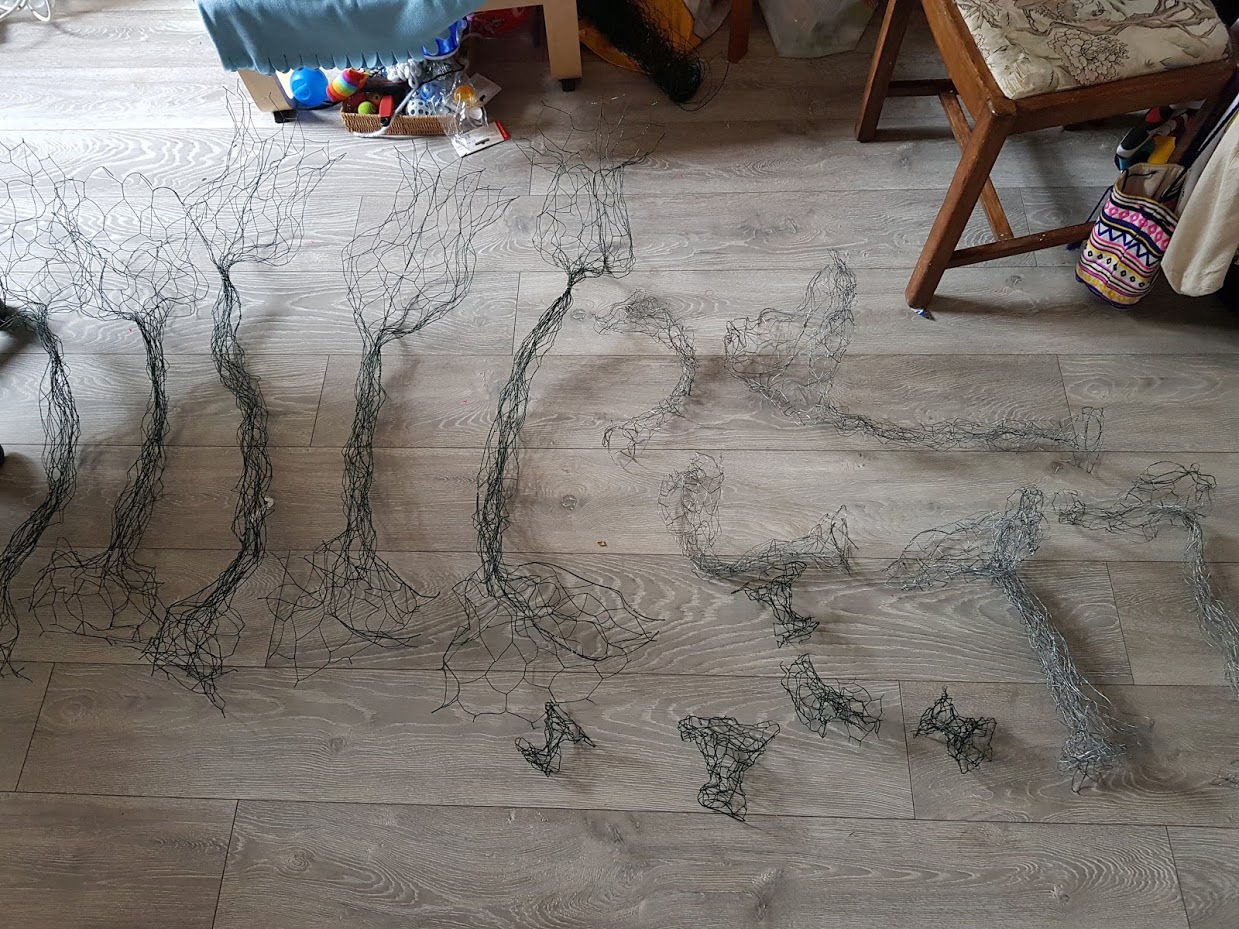
When designing my creatures, I went through a few options (particularly ants and meerkats, as previously discussed), after deciding that I wanted my creatures to appear ‘natural’ – I settled on creating twig-like figures. They are designed to look fragile and small, drawing inspiration from the ant which is known for its deceptive strength.
I also needed to consider their movement, I decided they ought to be made in such a way where they can be re-positioned after being constructed and painted. By doing this they will be able to stand and be adjusted at any given location. As a result of this, the structure needed to be wire, but I also wanted there to be a variety of sizes and widths. To secure the joints I used a product called ‘milliput’, this product cures hard and can be sculpted into shape beforehand, allowing a solid and secure fit for joints and larger more sculpted areas of the creatures.


There were four types of wire used for each figure, differing in widths, meaning different sized creatures could be made. They were then given texture to make them look like trees. This was tested before to ensure the desired effect could be achieved.
The wire frames were painted with a layer of tissue and latex, both of which are derived from natural sources. The tissue was used to create the texture and the latex was used to seal it and give a flexible skin, meaning the creature could move without risk of the sculpture breaking.
Christopher Columbus can be credited with discovering natural latex, he found the natives of Haiti played with balls of it as well as using it to provide a waterproof layer to clothing and footwear. Later in the nineteenth century, the garment containing rubber and fabric was patented as a raincoat. Seedlings were taken from their native country and transplanted here for farming, later these vast farms in countries like Singapore were created to farm these plants. Although liquid latex has had human input to make it into the product we use today, it is an example of a product born of Britain’s industrious nature and the colonialist empire that once was.
The paint I chose to colour the creature with was a mix of pros-aide and acrylic paint. I chose these products to allow flexibility. Pros-aide is an adhesive used to paint latex, because it is an adhesive it bonds well to the latex. When the acrylic is mixed with the glue it has a very pale appearance but as the glue dries clear the colour applied gives a highly pigmented final effect. This works well when trying to re-create a bark-like appearance.
In total, I chose to create 23 figures, which I hoped would give the impression of many creatures – replicating the pyramid system as mentioned above. I also wanted the number to be of significance, which I drew from the fact that it is 23 people that constitute the cabinet, including the Prime Minister, in the UK.
Locations
Bolton School
Selected to show possible growth between educational routes and hierarchy. Bolton school is a private school but has picturesque grounds, some of which are accessible to the public.


Rivington, Bolton
Selected as it covers a vast area with numerous different views. It has various landscapes from those which are heavily wooded to open, grassy areas. This land was owned by Lord Leverhulme who built a grand house and other impressive structures across his sprawling grounds, his enterprise later became the company currently known as Unilever. https://www.history.co.uk/biographies/lord-leverhulme


Astley Park, Chorley
Selected because of the manor house located on this land, which was once owned by the Charnock Family. It is now owned by Chorley council. https://historicengland.org.uk/listing/the-list/list-entry/1000943


Manchester Bolton Bury canal, Bolton
Selected because it symbolises a historic network linking industry to the land that is often overlooked. Located next to Moses Gate Country Park, it displays a clear connection between different regions of the North West.


Moses Gate Country Park, Bolton
Selected as it was in an area of Bolton that is less affluent. It is vast in views, there are areas for camping, play grounds, lakes for birds and other wild life and as well as wooded and open grass areas. Similar to Rivington it is also hilly, which is typical for the local area. The main reason this area was selected was because of its local history – previously on this land stood a paper factory, which is what Farnworth was known for during the industrial period. It is also located very close to motorways, A-road links and train lines – a contemporary symbol for connecting people to industry with faster, more efficient travel. https://www.lancswt.org.uk/our-work/projects/kingfisher-trail/moses-gate-country-park


As you can see, I mainly focused on wooded and green areas. I chose areas like this because of their heritage. Hierarchy is a phenomenon that occurs in a variety of social animal species as well as within human society and I wanted to choose a location that would represent that. Trees take years to grow strong and develop into the tall solid lifeforms I have taken pictures of. However, I also needed a location that was relevant in showing order and the divide between the contemporary and the historical and aged. This is why Moses Gate Country Park was selected, the specific location I shot in had a view of the motorway sign and the A666 behind it.


During the progression of this project, I also looked at works of fiction. I wanted to get a creative view of what authors, film makers and artists view as dysfunctional hierarchy. I looked at the novels ‘1984’ (Orwell, 1949) and ‘Animal Farm’ (Orwell, 1945) both written by George Orwell, these satires of dictatorship, the unbalanced, unfair and morally questionable people in leadership make a compelling story. Even within the television and film adaptions you are drawn into the story, emotionally provoked into thought. I also looked at other dystopian films like the ‘Blade Runner’ (Scott, 1982) and ‘Children of Men’ (Cuaron, 2006), both derived from science fiction novels they show a world so vastly different from ours, where there is complete control over human life.
Throughout this project, I have also looked at different artists that have not only inspired me but whose works resemble my own artistic practice. The first artist I looked into was Mark Dion. Dion incorporates taxidermic animals and museum collections to form installations for his art works. He has most recently been working in Australia, looking at a variety of species such as fish, horses, insects and fibres. His ability to work with museums and other archives allows for his work to reach alternative audiences and educate us not only on the pieces within the works but on wider issues. When looking at his work, I believe Dion is asking us to question a variety of different contemporary issues, such as our impact on the environment and how we place value on different items. In this respect, I aspire to create work such as his, using history to inform the questions we ask today. For this project, I am particularly interested in Dion’s work as it relies on collaboration, as I mentioned above. As my investigation has progressed the idea of collaboration and community has been an ever-increasing influence on my practical exploration. Although Dion’s work has been viewed in galleries, it is befitting for other locations as well, which reaffirms the value of art where ever it is seen. However, there is an element missing from Dion’s work that can be seen within another artists called Patricia Piccinini’s work and this is craftsmanship in production. Although it does take a lot of time and research to produce Dion’s installations, there is no fabrication of large props or sculptural work.

Piccinini is a sculptor who mainly creates works that cast a critical eye over relationships, not just between people but between the natural and manufactured, among other things. She creates original works of fantastical and sometimes grotesque appearing creatures. There is not necessarily a scientific or factual basis behind these works, but there is an emotive energy as well as a lot of technical skill and craftsmanship that goes into each creature, making them come to life. The materials that are used are familiar to me as a special effects prop maker and make-up artist and are not easy to master, so the technical capabilities of producing such work is not wasted on my critical eye. Piccinini’s ability to create a whimsically surreal world that is warm with emotion but the presence of darkness looming is impressive and is extremely well suited to a gallery setting. I also believe it introduces a form that has long been around but not celebrated in the contemporary art gallery setting. This form of art can be seen in film and television but it feels like it has been elevated. Although this is positive it is also a critique, Piccinini’s work is made for a gallery setting and although she is clearly influenced by the natural world, this element has not been included in her works.

Piccinini’s work is simultaneously natural yet unnatural and she has been able to introduce this craft to a new audience. I moved away from using products such as silicone and fibreglass for this project as I wanted to utilise natural material as much as possible. I also wanted textures and tones unlike flesh, which means more cost-effective materials can be used.
For this project, I also wanted to create a video which would show the research I had carried out visually. Throughout this project I used documentaries, television and film to initiate my research. I took inspiration from a number of places and artists including Cydnii Harris and Catherine Grant. I also wanted to look at some satirical, more comedic, work to help me decide what I wanted my video to be.
Cydnii Harris did a video essay entitled ‘Cotton – the fabric of Genocide’ that incorporated fictional footage from films mixed with real historical footage. The video is emotive and powerful and the use of footage that may be familiar adds to the final viewing. https://vimeo.com/user26521521
Catherine Grant is a well-renowned video essayist who has produced videos like ‘Dancing on Carnival Square’ and ‘The Haunting of the Headless Woman’. Both of these features use existing footage to critique their subject matter. There is no spoken word in the majority of Grant’s videos, and the use of instrumental music is often used to create audio atmosphere. Unlike Harris who uses spoken commentary from other films to tell a story. https://vimeo.com/361641676
Harris’ work is very striking and the story she is telling is poignant, I think the use of sound is more effective than Grant so I would like to adopt this approach. I do, however, think Grant’s ability to tell a story allows the viewer wider scope to contribute their own opinions, although this may have something to do with the subject matter of Harris’ video.
The video above was created by Grant, this work shows her comedic side. It still makes a meaningful point, however it adds an element of humour, which I find appealing.
I also looked at two other video makers, the features referred to are not video essays, however they are satirical critiques of people in power. The first is a British producer called Cassetteboy, his work can be seen on YouTube. Cassetteboy creates humorous videos on a variety of subjects. The video below uses footage taken from a number of different places and edited together to change the context.
Below are two other artists both from the States. Coldcut and TV Sheriff, like Cassetteboy, use existing footage to make satirical videos about different subjects. However, these edits do have other footage injected in to give it wider context, with what I believe a strong emotive feeling and power.
I would ideally like to amalgamate the video essay structure with the satirical fast editing of the later videos by Coldcut and TV Sheriff. Although I would like music within my video, I think the music would distract from the spoken word.
Creating my research video
For my symposium piece I chose to create a video displaying my research themes so far. I used footage gathered from the documentaries, TV series and films I used for reference, although I could not use them all, I needed to select those which would have the highest impact on the video to create the effect I wanted. Creating a video to display my research seemed fitting to my work and created diversity in the viewing of and engagement with my work at the symposium. Through my work I want to embed craftsmanship, and this was another form of doing so, although I believe there is something inherently contradictory about it as well. I think this is because of the instant nature of recording a video and uploading to whatever sharing platform you want, although the editing process can be time consuming. I used software called ‘Premier Pro’ to cut and edit the video clips I gathered and found YouTube to be the best resource to gather footage from.
I selected nature documentaries to show where my research journey began. Highlighting hierarchy in nature, there was a challenge in selecting only small parts of the footage gathered. Although after considering other videos it was important to select short clips to create a ‘punchy’ effect.
Fiction was also embedded within the video; I chose this particular clip for the audio. It was there to serve the purpose of stating hierarchy is inevitable and part of nature, or the circle of life.
From this point I needed to start comparing similarities between humans and our closest ancestors.
I chose to create juxtaposition between how successful we can be when we work for and with each other, and our aggressive nature – again highlighting the similarities of these behaviours within humans and our wild counterparts.
From there, I wanted to include some political footage, alongside a humorous clip. The aim of this was to again create contradictions displaying both sides of our natural behaviour. On one hand we are offensive and rude, and on the other we are civilised.
(Kunt and the Gang – That’s Why I’m Voting UKIP , 2014)
The latter are used to show progression and movement, not only for the local area but the country as a whole. The idea of incorporating these clips was, again, to show what can be achieved when working towards one greater goal, but also what can be lost when we become more insulated. Leadership can have a role to play in our openness to different people, places and genders (to name a few), which I believe is questionable at this current time. For me, this part of the video was important because the physical work I created was not just about hierarchy but also a reflection of what that means, it is a critical view on humans as individuals and whether we form a community for the purpose that we should… for the greater good.
The fact is, hierarchy and order are essential – that is why we are successful as a species. However, it is vital that we look after every individual in the ‘chain’ or ‘pyramid’, without looking after the bottom foundation layer then the system will not be successful. After all we are all human and deserve equal care and opportunity, don’t we?


Throughout the whole project I felt torn between the old and new. I found there were themes of class, psychology and politics when exploring hierarchy and I still feel there is plenty more I have not yet looked into.
Throughout my developmental journey, I am finding where my work fits. I do not think art should be restricted to a gallery nor should that setting give art its value. Craftsmanship within art should be appreciated no matter the environment, this is one of the main reasons I select natural environments as an artistic setting: I am aiming to challenge the viewer in seeing artistic value and diversity outside of the conventional gallery location.
Reference List
AllAboutScience.org. (2019). What is Social Darwinism. [online] Available at: https://www.allaboutscience.org/what-is-social-darwinism-faq.htm [Accessed 6 Oct. 2019].
Bbc.co.uk. (2014). BBC – Nation on Film – Decline of the cotton industry. [online] Available at: http://www.bbc.co.uk/nationonfilm/topics/textiles/background_decline.shtml [Accessed 21 Dec. 2019].
Dictionary.cambridge.org. (2019). HIERARCHY | meaning in the Cambridge English Dictionary. [online] Available at: https://dictionary.cambridge.org/dictionary/english/hierarchy [Accessed 18 Oct. 2019].
Dunbar, R., Rutherford, A., Garrod, B. and Saini, A. (2019). The Naked Ape at 50: ‘Its central claim has surely stood the test of time ‘. [online] the Guardian. Available at: https://www.theguardian.com/science/2017/sep/24/the-naked-ape-at-50-desmond-morris-four-experts-assess-impact [Accessed 14 Oct. 2019].
Encyclopedia Britannica. (2019). social Darwinism | Definition & Facts. [online] Available at: https://www.britannica.com/topic/social-Darwinism [Accessed 18 Oct. 2019].
HISTORY. (2019). Social Darwinism. [online] Available at: https://www.history.com/topics/early-20th-century-us/social-darwinism [Accessed 6 Oct. 2019].
World of Evil. (2006). Directed by Coldcuts and TV Sheriff. USA: Ed Jordan.
Boris Johnson’s Leadership Bid. (2019). Directed by Cassetteboy. UK: Self.
Dancing on the Carnival Square. (2019). Directed by C. Grant. Vimeo.
Jordan Peterson and the left, a new conversation. (2019).
Kettle, M. (2013). Seven social classes. Three political parties. It’s the mathematics of failure. The Guardian. [online] Available at: https://www.theguardian.com/commentisfree/2013/apr/03/seven-into-three-doesnt-go-maths-of-failure [Accessed 17 Nov. 2019].
The Video Essay Podcast. (2019). Episode 2: Catherine Grant. [podcast] Available at: https://www.youtube.com/watch?v=JlZ9u_8Vj1Y [Accessed 28 Dec. 2019].
Kevles, D. (2019). Evolution: Darwin: In the Name of Darwin. [online] Pbs.org. Available at: http://www.pbs.org/wgbh/evolution/darwin/nameof/ [Accessed 6 Oct. 2019].
Lynskey, D. (2018). How dangerous is Jordan B Peterson, the rightwing professor who ‘hit a hornets’ nest’?. The Guardian. [online] Available at: https://www.theguardian.com/science/2018/feb/07/how-dangerous-is-jordan-b-peterson-the-rightwing-professor-who-hit-a-hornets-nest [Accessed 15 Nov. 2019].
Orwell, G. (1945). Animal Farm. London: Penguin Books.
Orwell, G. (1949). Nineteen Eighty-Four. London: Penguin Books.
Nationalgeographic (2019). Meerkat. [online] Available at: https://www.nationalgeographic.com/animals/mammals/m/meerkat/ [Accessed 20 Oct. 2019].
Mcleod, S. (2019). Maslow’s Hierarchy of Needs | Simply Psychology. [online] Simplypsychology.org. Available at: https://www.simplypsychology.org/maslow.html [Accessed 21 Dec. 2019].
CATHERINE GRANT. (2019). CATHERINE GRANT. [online] Available at: https://catherinegrant.org/news/ [Accessed 28 Dec. 2019].
Sourcebooks.fordham.edu. (2003). Internet History Sourcebooks. [online] Available at: https://sourcebooks.fordham.edu/mod/25points.asp [Accessed 11 Nov. 2019].
Buck, L. (2018). Mark Dion: Welcome to my Wunderkammer. [online] Theartnewspaper.com. Available at: https://www.theartnewspaper.com/feature/welcome-to-my-wunderkammer [Accessed 21 Dec. 2019].
Clutton-Brock, T., Russell, A., & Sharpe, L. (2004). Behavioural tactics of breeders in cooperative meerkats. Animal Behaviour, 68, 1029-1040.
Ruse, M. (1980). Social Darwinism: The Two Sources. Albion: A Quarterly Journal Concerned with British Studies,12(1), 23-36.
Mazrui, A. (1968). From Social Darwinism to Current Theories of Modernization: A Tradition of Analysis. World Politics,21(1), 69-83.
Dion, M. (2017). The Department of Tropical Research: Aquatic and jungle field stations in 2 parts. [Mixed media] New York: Tanya Bonakdar Gallery.
Hodgson, G. (2005). Generalizing Darwinism to Social Evolution: Some Early Attempts. Journal of Economic Issues,39(4), 899-914.
Beck, N. (2012). Social Darwinism. IDEAS Working Paper Series from RePEc, IDEAS Working Paper Series from RePEc, 2012.
Tibayrenc, M., & Ayala, Francisco J., editor. (2017). On human nature : Biology, psychology, ethics, politics, and religion.
KALPAKLI, F. (2011). The Victorian Class-Consciousness As Reflected In Elizabeth Gaskell’s Cranford. Selcuk University Social Sciences Institute Journal, 25, 153–157. Retrieved from http://search.ebscohost.com/login.aspx?direct=true&db=sih&AN=64368180&site=eds-live
Virdee, S. (2019). Racialized capitalism: An account of its contested origins and consolidation. Sociological Review, 67(1), 3–27. https://doi.org/10.1177/0038026118820293
Gomes Orlando. (2011). The hierarchy of human needs and their social valuation. International Journal of Social Economics, 38(3), 237–259. https://doi.org/10.1108/03068291111105183
Sweet, R. (2015). How does class develop in the 18th century. [podcast] The development of class in Britain and Ireland. Available at: https://www.history.org.uk/podcasts/categories/433/podcast/406/class-in-18th-century-britain [Accessed 10 Nov. 2019].
Piccinini, P. (2019). No fear of depths. [silicone, fibreglass, human hair, clothing] Copenhagen: En Kaerlig Verden, Arken Museum.
Patriciapiccinini.net. (2019). PATRICIA PICCININI. [online] Available at: https://www.patriciapiccinini.net/465/2 [Accessed 3 Jan. 2020].
Dodgson, J. (2013). Gregory King and the economic structure of early modern England: an input-output table for 1688. Economic History Review, 66(4), 993–1016. https://doi.org/10.1111/1468-0289.12006
‘Clip from Meerkat Manor: A Family Affair’, Meerkat Manor, A Family Affair, 13:05 02/02/2009, BBC2 England, 25 mins. 00:03:59-00:04:29. https://learningonscreen.ac.uk/ondemand/index.php/clip/156855?bcast=31526383 (Accessed 26 Oct 2019)
Dynasties, (2018). [TV programme] one: BBC.
Life on Earth, (2014). [TV programme] 2: BBC.
Peep Show, (2012). [TV programme] 4: Channel 4.
Meerkat Manor, A Family Affair, 13:05 02/02/2009, BBC2 England, 25 mins. https://learningonscreen.ac.uk/ondemand/index.php/prog/005397F7?bcast=31526383 (Accessed 26 Oct 2019)
Meerkat Manor, (2009). [TV programme] 2: BBC.
Great Thinkers: In Their Own Words, Human, All Too Human, 21:00 01/08/2011, BBC4, 60 mins. https://learningonscreen.ac.uk/ondemand/index.php/prog/01DEC266?bcast=68206331 (Accessed 01 Nov 2019)
Grant, C. (2018). Daylight Raabery, Or, An Idiot’s Brexit. [online] YouTube. Available at: https://www.youtube.com/watch?v=w9T2l2P4Qxs [Accessed 20 Nov. 2019].
Kalarris, G. (2016). The Human Sexes. [online] Youtube.com. Available at: https://www.youtube.com/watch?v=fgfn-eoVU_w [Accessed 5 Dec. 2019].
The Real Mill, (2014). [TV programme] Channel 4: Channel 4.
Sutton, B. (2020). The 10 Best Booths at FIAC. [online] Artsy. Available at: https://www.artsy.net/article/artsy-editorial-10-best-booths-fiac [Accessed 3 Jan. 2020].
Video Clips
untitled. (2019). Directed by L. Reeves. Bolton: Own recording.
Youtube.com. (2014). YouTube. [online] Available at: https://www.youtube.com/watch?v=SrUDftDkH3E&t=64s [Accessed 9 Nov. 2019].
Youtube.com. (2014). YouTube. [online] Available at: https://www.youtube.com/watch?v=OA-76QeiuSQ [Accessed 8 Nov. 2019].
Youtube.com. (2014). YouTube. [online] Available at: https://www.youtube.com/watch?v=GibiNy4d4gc [Accessed 8 Nov. 2019].
Youtube.com. (2019). YouTube. [online] Available at: https://www.youtube.com/watch?v=V400oXh_YTQ [Accessed 8 Nov. 2019].
Youtube.com. (2019). YouTube. [online] Available at: https://www.youtube.com/watch?v=0WuATtU0mRA [Accessed 15 Nov. 2019].
Youtube.com. (2018). YouTube. [online] Available at: https://www.youtube.com/watch?v=SN7CLg2LixY [Accessed 15 Nov. 2019].
Youtube.com. (2016). YouTube. [online] Available at: https://www.youtube.com/watch?v=ANvzW_Uaaxw&t=52s [Accessed 15 Nov. 2019].
Youtube.com. (2018). YouTube. [online] Available at: https://www.youtube.com/watch?v=UWNnGcUD_a0 [Accessed 15 Nov. 2019].
Youtube.com. (2019). YouTube. [online] Available at: https://www.youtube.com/watch?v=6xJlPO5jqE8 [Accessed 15 Nov. 2019].
Youtube.com. (2011). YouTube. [online] Available at: https://www.youtube.com/watch?v=YJQUH-KolKA [Accessed 15 Nov. 2019].
Youtube.com. (2013). YouTube. [online] Available at: https://www.youtube.com/watch?v=Ggb5jBQ24Ew [Accessed 15 Nov. 2019].
Youtube.com. (2015). YouTube. [online] Available at: https://www.youtube.com/watch?v=5H161gLkvuo [Accessed 30 Nov. 2019].
Bibiolography
Chiou, J., & Pan, L. (2008). The Impact of Social Darwinism Perception, Status Anxiety, Perceived Trust of People, and Cultural Orientation on Consumer Ethical Beliefs. Journal of Business Ethics,78(4), 487-502.
Leyva, R. (2009). No Child Left Behind: A Neoliberal Repackaging of Social Darwinism. Journal for Critical Education Policy Studies,7(1), 364-381.
Meerkat Manor, Love Thy Neighbour, 13:05 03/02/2009, BBC2 England, 25 mins. https://learningonscreen.ac.uk/ondemand/index.php/prog/005953A8?bcast=31558402 (Accessed 26 Oct 2019)
Grant, C. (2018). Waterloo. [online] YouTube. Available at: https://www.youtube.com/watch?v=mibs81R2Ov8 [Accessed 18 Nov. 2019].
Shaw, W. (2019). Search | British History Online. [online] British-history.ac.uk. Available at: https://www.british-history.ac.uk/search/series/cal-treasury-books-papers [Accessed 30 Nov. 2019].
YouTube. (2015). F for Fake (1973) – How to Structure a Video Essay. [online] Available at: https://www.youtube.com/watch?v=1GXv2C7vwX0 [Accessed 24 Nov. 2019].
The National Archives. (2019). Political history in the 18th century – The National Archives. [online] Available at: https://www.nationalarchives.gov.uk/help-with-your-research/research-guides/political-history-18th-century/ [Accessed 30 Nov. 2019].
Digby, A. (1982). The Poor Law in nineteenth-century England and Wales. London: The Historical Association.
Excerpt from Stonebridge Park. (1981). Directed by P. Keiller. UK: self.
Anne, D. (2009). The Poor Law in Nineteenth-century England and Wales. [online] The Historical Association. Available at: https://www.history.org.uk/student/resource/2337/the-poor-law-in-nineteenth-century-england-and-wal [Accessed 30 Nov. 2019].
Hugh, G. (2010). Towards Reform in 1809. [online] The Historical Association. Available at: https://www.history.org.uk/student/resource/3044 [Accessed 29 Nov. 2019].
Ashton, N. (2015). Parliament and Party Politics. [podcast] The Emergence of party politics. Available at: https://www.history.org.uk/podcasts/categories/433/podcast/407/parliamentary-politics-in-the-18th-century [Accessed 12 Nov. 2019].
Maria, R. (2019). 15 Influential Political Art Pieces. [online] Widewalls. Available at: https://www.widewalls.ch/political-art/ [Accessed 27 Dec. 2019].




 Expanded Art Practice