Within this blog I will be discussing my practical exploration and giving additional evidence of my Real World Context module. I aim to summarise my research and artistic influences as well as outline my experimentation, culminating in a final image.
This work will form part of my ‘Monster hidden in plain sight’ collection and will allow me to explore another new sculptural medium. I always try to take inspiration from a number of sources when developing my work and during my research for this piece I stumbled across the following video on social media.
I found this video very shocking to see. However, it inspired me to incorporate plastic bags within my next project, highlighting a very current issue we are experiencing on the global scale.
I needed to investigate further into artists that work within this specific field, so I looked at two types of artists within very different mediums and approaches. The first area I looked into was artists who worked with nature and embedded the natural environment into there work, with the aim to focus on an artist who works in a different way to me.
Mark Ware
Mark Ware has created works titled ‘Wavelength’ focusing on how the environment effects our well being and how the natural world is beneficial to keeping us mentally healthy. Ware approaches his work in a scientific manner, collaborating with neuroscientists and psychologists researching the effects of natural visual and audio stimuli on individuals. His findings show people have a positive response to sights and sounds found in nature, which has the potential to improve peoples general well being and act as stress reducer. From this investigation Ware went onto a project entitled ‘Reflecting Nature’ where he produced a number of reflective and symmetrical prints looking at rural/natural scenes. When exhibited the audience responses were monitored to see whether artistic intervention affected their emotions. These findings displayed a positive effect on the audience. http://markware.co.uk/the-wavelength-project-3/
New Scientist magazine also worked with Ware to develop his findings in a scientific manner, and show how this could be implemented in a wider range of areas. https://www.newscientist.com/article/2096555-missing-the-natural-world-just-add-multimedia/

Mark Ware, 2016
This work really highlights the importance of nature and art on the spectator and the impact of image or sound on an individuals well being. Ware’s work has helped me understand the importance of protecting our landscape for the benefit of everyone’s well being. This has also informed my practical exploration in a direction I hadn’t expected nor thought of previously. From this I decided to do further research into locations for my physical sculptures to be placed, as I wanted to create a feeling of well being in my final image with the juxtaposition of plastic pollution.
The next Artist I looked at was Thomas Dambo.
Thomas Dambo, Artist
Thomas Dambo is a Danish Artist based in Copenhagen, his art works are sculptural and made from recycled materials. Dambo’s work is hugely inspirational to me, as it embodies the type of whimsical nature I see in my work, as well as being able to tell the audience a story of environmental importance.
Dambo really draws audiences into his art, it’s engaging and encourages people to explore an environment they may not have had interest in previously. Many of his sculptural pieces are based in woodland areas, where he creates “Wooden Giants”. However, for my current project I am most interested in his 2018 works titled ‘Future Forest’, this piece is completely constructed from recycled plastic, which was collected from Mexican land fill sites. As an environmental activist he saw the large amount of plastic waste we produce globally, along with the changes Mexico City has made to adapt to the growing population and enlisted volunteers to help him create this plastic forest.
Both artists make compelling statements about the natural and the artificial. Making the viewer realise the collision that happens everyday and how how that effects us globally. Although both artists are making different points and have different messages, both are highlighting the contemporary issue of environment and how it is important to maintain. In a modern society of instant everything our consumption of physical and mental assets is overwhelming, causing a sense of anxiety and overcrowding that literally over spills into the landscape around us.
Locations
For this piece I explored a number of outdoor locations. I selected public parks, as I knew contextually my image needed to include nature and greenery. I also wanted to select a location with natural beauty and the appearance of being unspoilt.
I explored locations around the Greater Manchester and Manchester area, such as:

Marie Louise Gardens, Didsbury 
Rivington, Bolton 
Yarrow Valley, Chorley 
Fletcher Moss Park, Didsbury
I decided on Fletcher Moss park in Didsbury Manchester and there was a number of reasons for this. Firstly within it grounds there was a rockery/botanical gardens, which contains a vast amount of plant life both exotic and native, this would provide a strong visual contrast between the plastic sculptures and the environment. The next factor in this decision was the clean nature of this park. In the botanical gardens there are no dogs allowed meaning plants are undamaged an no chance of dog fouling, as well as this it is well maintained, meaning no litter. Finally, I chose this location for it cultural value. I wanted a location people are likely to recognise with a local history. This park received funding to support its restoration after 2011 when the council appeared to have no further use for the parsonage building within the park. The park is now looked after by a dedication group of people called ‘Friends of Fletcher Moss Park’. This emphasis of community spirit really adds to your experience in the park and the care that is involved maintaining it.


These are a few image I collected of the rockery and botanical gardens.
Research
Throughout this module I felt it was important to look at real animals. I wanted to visually study specific creatures that I felt linked to our local environment as well as some animals related to the plant life I wanted to photograph. From my visit to the botanical gardens I knew I would to include the Brazilian Giant Rhubarb. When looking at animals native to south america there was an overwhelming amount to choose from, so I went back to considering a design and specific traits I wanted my creatures to have.
The work I wanted to create was about a change in landscape, and I needed to think about where my creatures would be positioned and how they would have adapted to live in an environment engulfed in plastic. From this I went and looked at the animals in the Manchester Museum and decided to look closer at bats, moles and capybara. These were selected for their unusual characteristics, for example bats ears are large, as they do not rely on their eyes for guiding them, a mole is the same, however they have large five digit claws to help them travel underground. I also focused on capybara as it is the largest rodent in the world but it is native to South America.

The collection the closely studied 
Capybara 
Long eared Bat 


Brown Bat 
Mole 
During this project I was able to build a good rapport with the assistant curator to natural environments Rachel Petts, she allowed me special access to view these animals closely. During this time I sketched small studies of specific parts of each animal, to see what shapes and elements of each would fit into my creature sculpt.
When developing my idea I had to consider how I wanted my creatures to appear and in my mind when imagining a plastic filled world I thought about animal life moving underground. Then, when coming up to the surface they would have to adapt to looking like their surroundings. This would indicate to me that the creatures wouldn’t be particularly large in overall size and like a bat and mole they wouldn’t need use of their eyes, as sight is not their main sense. However, they would require other well-endowed sensory organs, such as ears.
When it came to designing and building the creatures I felt that the mole claws and nose fit well with the bat ears, so I decided to not incorporate the capybara within the creature concoction.
Making
To start construction I went about carrying out small experiments to tests the materials I wanted to use, I had the idea of melting plastic bags to form shapes and wildlife, but I needed to see how the plastic would react to being melted. I started this process by making a very quick test sculpt using polymer clay, as this particular clay bakes solid and therefore will not melt under heat and would keep its shape.


The plastic shrunk when heated, causing it to form a tight seal and outline the shape underneath, as well as this it went it rigid and lost some of it’s flexibility.
After this I went about testing formless melted plastic pieces, which came out looking like leaves and were light and formed a wrinkled texture in areas. I made a number of these smaller pieces and attached them onto a fishing line. I did this to ensure they did not blow away as I also wanted to test hanging these pieces. When I went on location to look for where I would shoot the final image I found a part of Fletcher Moss park which had sections of trellis and hanging plants. And as I went in the spring, the plant life looked vibrant and overgrown. This is where I test shot these plastic hangings.


I did find they looked a little lost in this space, although I have not ruled this design choice for a gallery/indoor space later on.
As mentioned previously I found the giant rhubarb really interesting, as it is so unusual to look at and it was familiar but also so alien at the same time. This informed my next creation, the plastic plant life. The idea behind this was to create a setting for the plastic covered creature and I took inspiration from the size of the rhubarb and made some wire frames outlining the shape of these plants, I made these to be approximately midway height to the rhubarb.

Photo taken as height reference 
Potentially final shot location
As well as these I made some wire frames for some other plant life in smaller varying sizes to add variation to the final scene.
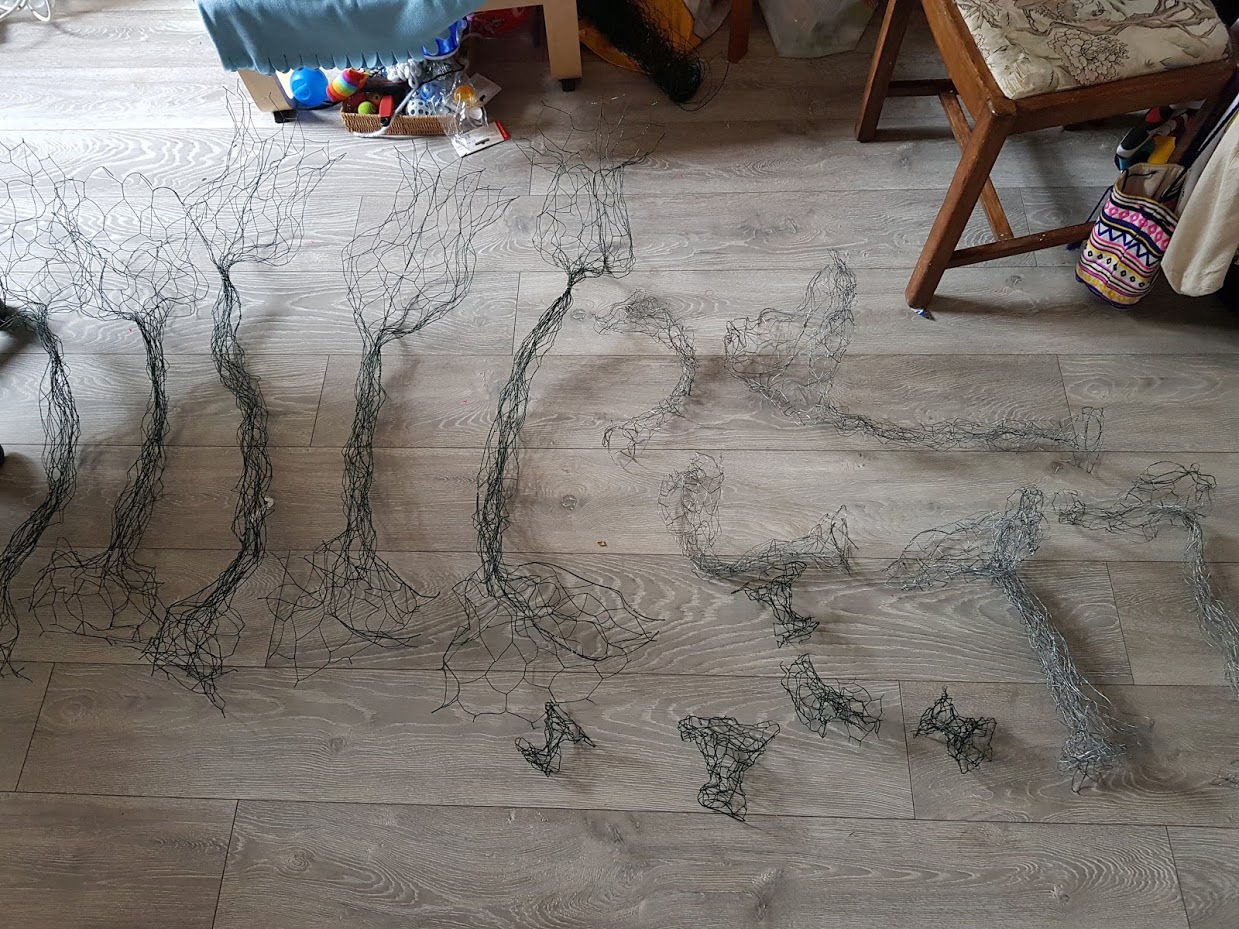
From this stage I went about melting plastic onto the wire frames. I wanted to use white as the my key tone, allowing the artificial plants to stand out and the layers of melting and wrinkling easier to see.

Stone were places into the bottom of the wire frames to ensure they stood up. 
Layers of plastic melted over the wire. 
I chose to form my creatures in the same way as I had previously tested. I used a flesh coloured clay to create the appearance of raw flesh underneath the layers of plastic.

I made teeth and claws from milliput, which made them stand out. I sculpted a rough shape for the creatures and did not add to much detail as I knew this would be covered. I kept the ears as a wire frame as I wanted the to have a translucent quality to them once the plastic was melted over.
The Final shoot
In order to do this shoot I had to ask Manchester council for permission, as well as fill out a number of forms. Once this was approved I booked three provisional days which were the 13th, 14th and 15th of August to ensure if the first day was raining I could return on the following days and still shoot. I also booked my photographer in and ensured he was available for all of these dates.
Luckily the weather was suitable for the shoot on the 13th August. I was able to get a variety of images and also performed an extra shoot in a different part of the botanical gardens.
Below are some behind the scenes images on the day of the shoot from both locations within the gardens.


These were some of the professional images taken on the day, but not selected from my final location.


Finally, these closer professional images below show the final chosen composition and location.


In this project I wanted to achieve an overall goal of creating a final image(s) which reflect how plastic waste is changing and affecting our environment. I wanted to embed my craft of sculpting while challenging myself to use and new medium and material, which came from the video ‘Plastic Storm’ that inspired me to look into using plastic bags as a new sculptural medium.
The use of unwanted, discarded plastic bags within my piece does follow on from my last project, which was made from recycled novels (although not deliberately). The use and re-purposing of an everyday or commonly used object is particularly interesting in this case as an man-made artificial object was given the appearance of organic life and this use of this material gives a certain sense of suffocation.
My colour choice for the plastic wildlife was very deliberate, as I wanted to create a initial feeling of innocence and virtue but with a deeper subtext of pollution and disregard.

‘Hidden’

‘The floor’

‘Distant’
Nature is resilient and may evolve within our unnatural waste. Or as Dr. Ian Malcolm once put it “Nature finds a way”. (Jurassic Park, 1993)
Referencing list
Artscouncil.org.uk. (2016). How art that reflects nature can be good for us | Arts Council England. [online] Available at: https://www.artscouncil.org.uk/news/can-art-make-us-feel-better-how-art-reflects-nature-can-be-good-our-wellbeing [Accessed 20 Jul. 2019].
Dambo, T. (2018). The Future Forest. [online] Thomasdambo.com. Available at: https://thomasdambo.com/works/the-future-forest/ [Accessed 20 Jul. 2019].
Dambo, T. (2018). THE FUTURE FOREST – 3 Tons of plastic waste turned into a colorful forest.. [online] YouTube. Available at: https://www.youtube.com/watch?v=XTC8ie_HB5c [Accessed 20 Jul. 2019].
Jurassic Park. (1993). [film] Directed by S. Spielberg. Hollywood: Universal Pictures.
Markware.co.uk. (2019). markware.co.uK. [online] Available at: http://markware.co.uk/the-wavelength-project-3/ [Accessed 15 Aug. 2019].
Swati, I. (2019). Plastic storms in Croatia. [online] YouTube. Available at: https://www.youtube.com/watch?v=K3jIjm6cKF4 [Accessed 20 Jul. 2019].

 Expanded Art Practice